
on 04/05/2026
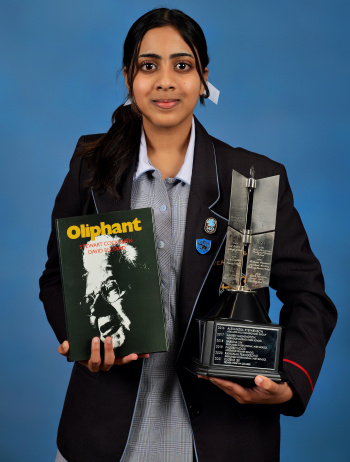
Get to know Shanza!
How did you first get involved in OSA?
My journey with the Oliphant Science Awards (OSA) began in Year 7 at Norwood Primary School and was sparked by a call for entries in our school newsletter. I was looking for a way to take my passion for STEM beyond the classroom and explore scientific topics independently. That year, I chose to analyse the drinking water quality at public playgrounds across South Australia. Through this project I was able to perfectly bridge my interests in health and environmental science. This first entry was a transformative learning experience as it challenged me to adopt a researcher’s mindset, and I significantly refined my scientific writing skills through this experience. Ultimately, winning a prize that year did more than just build my confidence in undertaking scientific endeavours as it turned my interest in science into a lifelong pursuit.
Why do you participate?
I participate because OSA offers a platform to investigate real-world problems through a scientific lens. What keeps me coming back isn't just the thrill of the inquiry, but the challenge of distilling complex data and scientific concepts into meaningful insights. Each project allows me to dive deep into a specific subject, whether it's through a formal experiment or scientific writing. Participation in OSA helped foster a level of independent thinking that goes beyond what a typical school setting offers. This experience has deepened my passion for STEM and inspired me to pursue a future career in scientific research.
What advice would you give to other OSA entrants?
My advice to future entrants is to recognise that passionate curiosity is your most valuable scientific tool. In research, you will inevitably hit dead ends or face data that doesn't make sense; let your interest in the 'unknown' be what pulls you through those moments of frustration. Science is rarely a straight line; it’s an iterative process. Never stop asking 'why,' and treat every failed experiment not as a defeat, but as a necessary pivot toward the right answer. If you let your curiosity lead the way, the work stops being a task and starts becoming a discovery.
What is your favourite project that you have submitted?
My favourite project is still my very first entry, where I tested the drinking water quality at public playgrounds. While I’ve explored much more complex topics since then, that project stands out because of how immersive the fieldwork was. There was something uniquely rewarding about traveling to different sites, collecting samples, and seeing the immediate real-world relevance of my data. It was the first time I felt like a 'true scientist' rather than just a student, and that feeling of discovery is exactly what has driven me to keep participating in the years following.
Share:


